
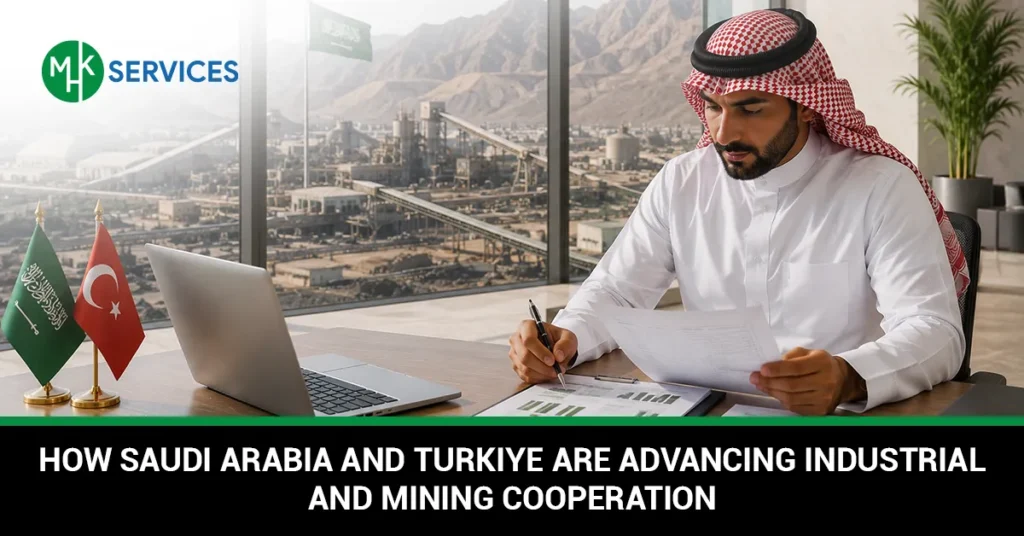
Two of the region’s most dynamic economies are writing a new chapter together. Over the past few years, Saudi Turkiye Industrial Cooperation has moved from occasional diplomatic talk to a working relationship built on signed agreements, ministerial visits, and shared industrial goals. At MHK Services, we track these developments closely because they open real doors for businesses looking to enter, supply, or partner within these two markets. This blog breaks down what is actually happening, why it matters, and where things may be heading next, so that decision-makers evaluating either market have a clear, practical picture rather than headline-level assumptions.
A New Chapter in Saudi Turkiye Relations
For decades, Saudi Turkiye Relations were shaped mostly by trade in consumer goods and general diplomatic goodwill. That has changed. Since 2023, ministerial visits between Riyadh and Ankara have produced concrete agreements on mining, transport, and industrial policy. In early 2026, a high-level visit by Turkiye’s president to Riyadh led to a broad expansion of cooperation covering trade, investment, energy, and digital transformation, with both governments explicitly linking Saudi Arabia’s Vision 2030 to Turkiye’s own long-term economic strategy.
This shift matters because it signals something deeper than a single deal. It reflects a strategic decision by both governments to treat each other as long-term industrial partners rather than short-term trading counterparts.
Why Saudi Turkiye Industrial Cooperation Matters
The core of Saudi Turkiye Industrial Cooperation lies in complementary strengths. Saudi Arabia has capital, vast mineral reserves, and an economy actively diversifying away from oil. Turkiye brings decades of manufacturing experience, a mature industrial base, and strong engineering and construction capabilities. Put together, the two countries can build supply chains that neither could build as efficiently alone.
Saudi officials have described the relationship in industry and mining as having reached a genuinely strategic level, pointing to opportunities across nearly every sector included in the Kingdom’s industrial strategy. That framing is not just diplomatic language it reflects real project pipelines already in motion, from joint mineral processing to logistics infrastructure connecting the two regions.
For manufacturers and investors, this complementary structure creates concrete openings. Turkish companies with established production lines can localize part of their manufacturing inside Saudi Arabia to serve Gulf demand directly, while Saudi capital can flow into Turkish industrial capacity that already has export routes into Europe and Central Asia. Both governments have made clear, through repeated ministerial statements, that they see this as a long-term structural relationship rather than a short-term trade adjustment.
Inside the Saudi Mining Sector Transformation
No discussion of this partnership is complete without looking at the Saudi Mining Sector directly, since minerals sit at the center of the cooperation.
Mineral Exploration: Saudi Arabia is expanding geological surveys and mapping the mineral-rich Arabian Shield to identify new opportunities for international investment and resource development.
Mining Technology: Turkish expertise in drilling, laboratory standards, geological services, and clean mining technologies is helping strengthen Saudi Arabia’s technical capabilities and improve exploration efficiency.
Mineral Processing & Production: Combining Saudi resources with Turkish processing and engineering expertise can help accelerate the transition from exploration to production, processing, and mineral exports.
Trade and Investment Opportunities
The growing cooperation between Saudi Arabia and Turkiye is creating practical opportunities for businesses across several industries:
- Manufacturing: Turkish manufacturers can explore local production and supply opportunities in Saudi Arabia to serve growing Gulf demand.
- Mining and Mineral Processing: Companies with exploration, processing, and mining technology expertise can benefit from Saudi Arabia’s expanding mineral sector.
- Logistics and Transport: Improved regional connectivity could create opportunities for logistics providers, freight companies, and infrastructure businesses.
- Energy and Clean Technology: Renewable energy, hydrogen, power infrastructure, and related technologies offer potential areas for joint investment.
- Industrial Supply Chains: Businesses can build cross-border supply networks by combining Saudi capital and resources with Turkish manufacturing and engineering capabilities.
Key Agreements Driving Saudi Turkiye Industrial Cooperation
Several formal agreements now anchor Saudi Turkiye Industrial Cooperation in practical terms rather than intentions:
- A mining sector memorandum of understanding covering knowledge transfer, exploration, and critical minerals used in solar panels and electric vehicles.
- A joint committee protocol on trade, industry, investment, infrastructure, and energy, building on a coordination council that has met periodically since 2016.
- Ongoing feasibility studies for a rail link connecting Saudi Arabia and Turkiye, intended to ease regional logistics challenges.
- Expanded energy cooperation spanning petrochemicals, power grid connectivity, renewables, and clean hydrogen.
Each of these agreements was signed following direct ministerial engagement rather than lower-level negotiation, which is itself a signal of how seriously both governments treat this relationship. It also means the terms tend to be backed by real political commitment, not just technical working groups that can stall without high-level support.
The table below summarizes how these efforts break down by sector.
| Sector | Type of Cooperation | Expected Impact |
| Mining & Critical Minerals | Knowledge transfer, joint exploration, R&D | Faster development of Saudi mineral reserves |
| Industrial Manufacturing | Investment, supply chain integration | Diversified non-oil industrial output |
| Transport & Logistics | Rail link feasibility studies | Reduced regional shipping and transit costs |
| Energy | Petrochemicals, hydrogen, power grids | Lower-emission industrial energy supply |
Challenges Still Facing the Partnership
Progress has not been without friction. Aligning regulatory standards, customs procedures, and investment protections between two large, independently regulated economies takes time. Currency volatility on the Turkish side and evolving local-content requirements in Saudi Arabia add further complexity for companies trying to plan multi-year projects. Regional security dynamics, including broader Gulf defense arrangements involving Turkiye, also shape the pace at which some agreements move from paper to implementation.
Language differences, varying accounting and compliance standards, and the sheer scale of documentation required for cross-border industrial contracts also slow things down in practice. Companies that underestimate this administrative layer often lose months they had not budgeted for. None of this undermines the overall direction of the relationship, but it does mean businesses entering this space need accurate, up-to-date guidance rather than assumptions based on older trade patterns.
The Road Ahead for Saudi Turkiye Industrial Cooperation
Looking ahead, Saudi Turkiye Industrial Cooperation is likely to deepen, with both countries focusing on investment, manufacturing, infrastructure, and energy partnerships:
- Vision 2030: Saudi Arabia is entering the final phase of Vision 2030, with greater emphasis on implementation and private-sector participation.
- Turkish Industrial Strategy: Turkiye is actively seeking Gulf investment and technical partnerships to expand its industrial capabilities.
- Critical Minerals: Mining and mineral processing are expected to remain important areas for cooperation.
- Rail Infrastructure: Proposed rail connections could strengthen regional logistics and physical trade links.
- Clean Energy: Saudi capital and resources combined with Turkish engineering expertise could support new clean-energy projects.
- Early-Mover Opportunities: Companies in mineral processing, industrial equipment, and logistics may benefit from entering the market early, before competition and regulatory requirements become more established.
Conclusion
The momentum behind Saudi Turkiye Industrial Cooperation is real, backed by signed agreements, ministerial engagement, and complementary economic strengths rather than short-term political goodwill. For businesses evaluating opportunities in mining, manufacturing, energy, or logistics between these two markets, understanding the practical mechanics of this partnership is essential.
MHK Services works with organizations navigating exactly this kind of cross-border opportunity, helping translate high-level cooperation into workable, on-the-ground strategy from market entry and regulatory guidance to identifying the right local partners on either side of this fast-moving relationship.
Frequently Asked Questions
What is Saudi Turkiye Industrial Cooperation actually based on?
It is built on formal government agreements covering mining, manufacturing, energy, and transport, supported by regular ministerial visits and joint committees.
Which sectors benefit most from the Saudi Mining Sector partnership with Turkiye?
Critical minerals, exploration services, and clean mining technology see the most direct technical exchange between the two countries.
How does the rail link project fit into Saudi Turkiye Relations?
It is a proposed connection through Jordan and Syria designed to reduce regional logistics costs and strengthen physical trade links.
Is this cooperation new, or has it been building for years?
It has roots going back to 2016 but has accelerated sharply since 2023, with several major agreements signed in the past two years.
What risks should businesses consider before entering this market?
Regulatory alignment, currency exposure, and evolving local-content rules are the main factors that require careful planning before committing capital.