
Cybersecurity Services in Saudi Arabia (MHK Services)

What Is Cybersecurity and Why It Matters for Saudi Businesses
Cybersecurity protects digital systems, networks, and data from unauthorized access, breaches, and regulator‑related risks. For Saudi businesses, cybersecurity ensures compliance with national standards, safeguards customer trust, and prevents costly disruptions. It is not just about defense — it is about resilience and credibility.
provides direct cybersecurity solutions tailored to Saudi companies. Our team delivers end‑to‑end protection, monitoring, and compliance alignment, ensuring businesses achieve security, transparency, and operational confidence.
What Types of Cybersecurity Services Do Businesses Need
Different companies require tailored cybersecurity depending on their industry, size, and compliance obligations. MHK Services provides:
Network Security We configure firewalls, intrusion detection, and secure VPNs.
Data Protection & Encryption We implement encryption protocols to safeguard sensitive records.
Threat Monitoring & Incident Response We deploy systems to detect, respond, and recover from cyberattacks.
Compliance & Audit Readiness We align systems with Saudi cybersecurity regulations and prepare audit‑ready documentation.
Cloud Security We secure cloud platforms with access controls and compliance‑aligned monitoring.
Which Businesses Need Cybersecurity in Saudi Arabia
Cybersecurity is essential for all companies operating digitally in Saudi Arabia.
- Finance & Banking – requiring regulator‑aligned data protection.
- Healthcare & Pharmaceuticals – needing patient record security.
- Retail & E‑Commerce – requiring secure payment gateways.
- Real Estate & Construction – needing project and contract data protection.
- SMEs – requiring affordable, scalable cybersecurity solutions.
What Are the Benefits of Cybersecurity Services
Cybersecurity delivers measurable advantages by focusing on compliance, efficiency, and resilience.
- Regulator Compliance Aligns systems with Saudi cybersecurity standards.
- Reduced Risk of Breaches Protects against unauthorized access and data loss.
- Operational Continuity Ensures systems remain functional during cyber incidents.
- Customer Trust Strengthens brand credibility with secure platforms.
Our Process for Delivering Cybersecurity Services
Cybersecurity requires a structured approach. At MHK Services, we manage each stage carefully to ensure systems are complete, regulator‑ready, and aligned with Saudi standards.
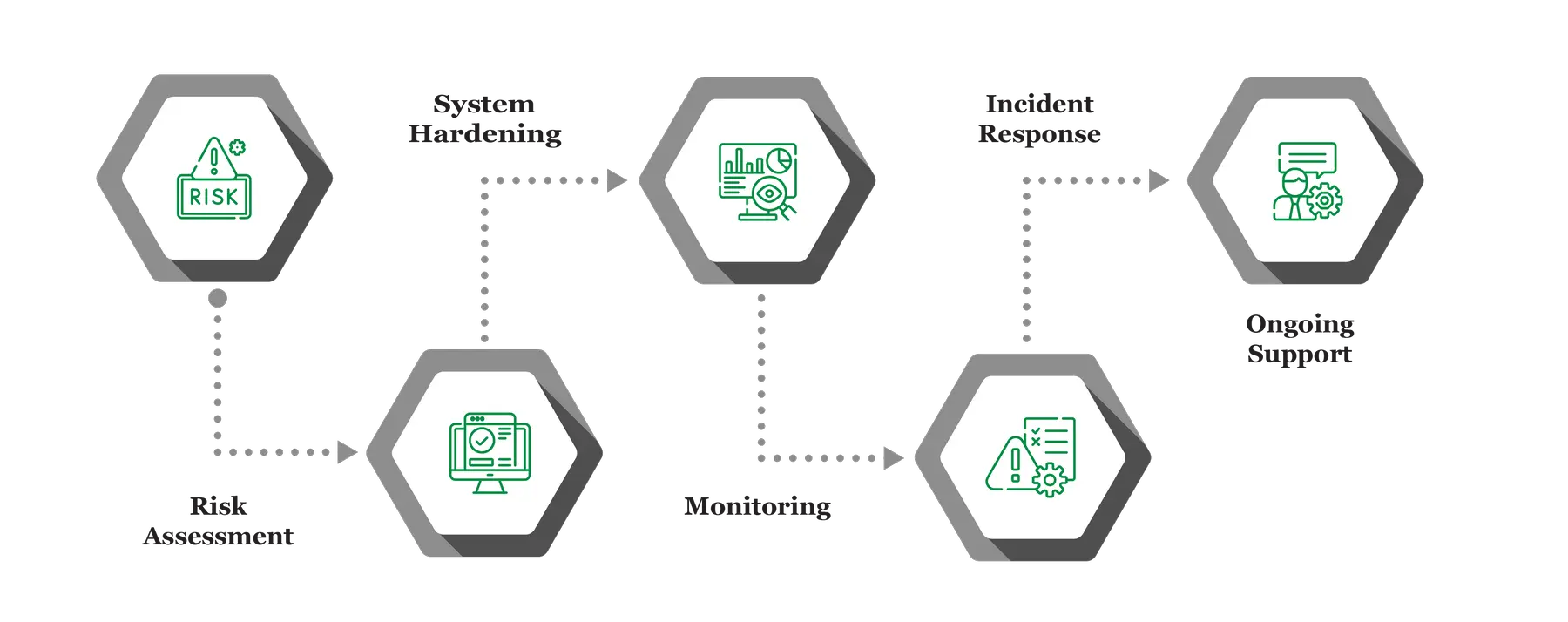
Risk Assessment – We identify vulnerabilities and define security objectives.
System Hardening – Firewalls, encryption, and secure protocols are deployed.
Monitoring – Threat detection systems are implemented.
Incident Response – Plans are prepared for rapid recovery.
Ongoing Support – Continuous updates and compliance checks are provided.

What Challenges Do Companies Face in Cybersecurity
Companies often struggle with cybersecurity due to unclear scope, incomplete records, and technical issues.
Unclear Objectives Without defined goals, security measures become ineffective. MHK Services helps set clear targets.
Incomplete Records Missing audit logs or compliance registers delay implementation. We organize complete packs.
Technical Errors Incorrect configurations cause vulnerabilities. We ensure proper setup.
User Resistance Teams may resist new protocols. We provide training and awareness programs.
Book an Appointment with Us
Schedule a consultation with MHK Services today and discover how our expert Actuarial Valuation and financial consulting services can enhance the accuracy and reliability of your financial records.
Documents Required for Cybersecurity in Saudi Arabia
To stay compliant, businesses must prepare and maintain certain records.
- Audit logs and compliance registers
- Contracts and governance documents
- ERP/CRM data logs
- VAT invoices and reconciliations (for e‑commerce)
- Cybersecurity policies and incident reports
Contact Us
Which Laws and Authorities Govern Cybersecurity in Saudi Arabia
Cybersecurity systems must align with Saudi regulations to ensure compliance and data protection.
- National Cybersecurity Authority – Oversees cybersecurity standards and enforcement.
- Ministry of Commerce (MoC) – Reviews governance and statutory filings.
- ZATCA – Ensures VAT‑related systems are secure.
- CITC – Regulates digital platforms and network compliance.
Cost & Pricing Overview for Cybersecurity Services
The cost of cybersecurity in Saudi Arabia depends on company size, documentation maturity, and customization needs.
- Company Size Larger firms require broader protection, while SMEs fall into lower ranges.
- Customization Depth Tailored security protocols add to cost but strengthen resilience.
- Integration Effort Connecting ERP, CRM, and cloud systems increases preparation effort.
Technology & Tools Used in Cybersecurity
MHK Services integrates exact tools to deliver cybersecurity solutions.
Industries We Serve with Cybersecurity in Saudi Arabia
Cybersecurity applies across diverse industries, each with unique compliance requirements. MHK Services adapts its approach to meet sector‑specific needs.
- Finance & Banking
- Healthcare & Pharmaceuticals
- Retail & E‑Commerce
- Real Estate & Construction
- SMEs & Family‑Owned Businesses
What Is Cyber Security and Why Saudi Businesses Cannot Afford to Ignore It
What is cyber security is one of the most searched questions by business owners who have recently experienced a data breach or received a regulatory warning. At its core, cyber security is the practice of protecting digital systems, networks, and sensitive data from unauthorized access, theft, and disruption. In Saudi Arabia’s increasingly digital economy, a single successful cyberattack can result in financial losses, regulatory penalties, and permanent reputational damage that takes years to recover from.
How the National Cybersecurity Authority Shapes Security Standards in Saudi Arabia
The National Cybersecurity Authority is the primary regulatory body responsible for setting and enforcing cybersecurity standards across all sectors in Saudi Arabia. It issues the Essential Cybersecurity Controls framework that businesses must align with to demonstrate regulatory compliance and protect critical digital infrastructure. Companies that fail to meet NCA requirements face regulatory scrutiny and increasing difficulty securing government contracts or partnerships with major Saudi enterprises.
What Cyber Security Certifications Mean for Businesses Operating in KSA
Holding recognized cyber security certifications signals to regulators, clients, and partners that a business takes data protection seriously and has implemented internationally accepted security controls. Certifications such as ISO 27001 demonstrate that a company’s information security management system has been independently verified against global standards. For businesses in Saudi Arabia pursuing government contracts or working with large enterprises, relevant certifications are increasingly becoming a prerequisite rather than an advantage.
How to Evaluate Cyber Security Companies in Saudi Arabia Before Making a Commitment
Choosing among cyber security companies in Saudi Arabia requires careful assessment of their regulatory knowledge, technical capability, and industry experience. Businesses should look for partners who understand NCA requirements, have experience across their specific sector, and can demonstrate a structured approach to risk assessment and incident response. A reliable cyber security partner does not just install tools but builds a long term security framework that evolves alongside the business and the threat landscape.
Why Choose MHK Services for Cybersecurity
Choosing the right partner for cybersecurity is critical for compliance and business confidence. MHK Services provides direct setup, prepares security‑ready documentation, and supports management throughout the process.
- Local compliance expertise aligned with Saudi regulators
- Security‑ready records prepared for regulators and investors
- Exact tools integrated for faster, simpler protection
- Customised solutions adapted to company size and industry
- Trusted delivery of cybersecurity systems
Note: The above-mentioned services are provided via network firms if not provided directly
Contact MHK Services for Cybersecurity in Saudi Arabia
Cybersecurity in Saudi Arabia is essential for compliance, transparency, and operational resilience. MHK Services provides direct setup, prepares documentation, and delivers regulator‑aligned systems to ensure obligations are met and records are complete. Schedule a consultation today to receive a customised cybersecurity checklist and regulator‑aligned support.
FAQs: Cybersecurity in Saudi Arabia
Common signs include unexpected system slowdowns, unauthorized access attempts flagged in audit logs, unusual outbound data transfers, and unexplained changes to files or user permissions. Businesses without active threat monitoring often discover breaches only after significant damage has already occurred.
Small businesses are increasingly targeted precisely because they typically have weaker security controls than large enterprises. Cybercriminals view SMEs as easier entry points, sometimes using them to access larger partner organizations within the same supply chain.
A firewall is a single layer of protection that filters incoming and outgoing network traffic while a full cybersecurity solution covers endpoint protection, threat monitoring, incident response, data encryption, and compliance management simultaneously. Relying solely on a firewall leaves significant security gaps that sophisticated attackers can easily exploit.
Risk assessments should be conducted at least annually and immediately after any major system change, data breach, or significant regulatory update. Regular assessments ensure emerging threats and new vulnerabilities are identified and addressed before they can be exploited.
Yes, NCA requirements apply to cloud hosted systems, meaning businesses must ensure their cloud platforms meet the same security and data protection standards as on premise infrastructure. Cloud providers used by Saudi businesses should be verified for NCA alignment before any sensitive data is stored or processed on their platforms.