
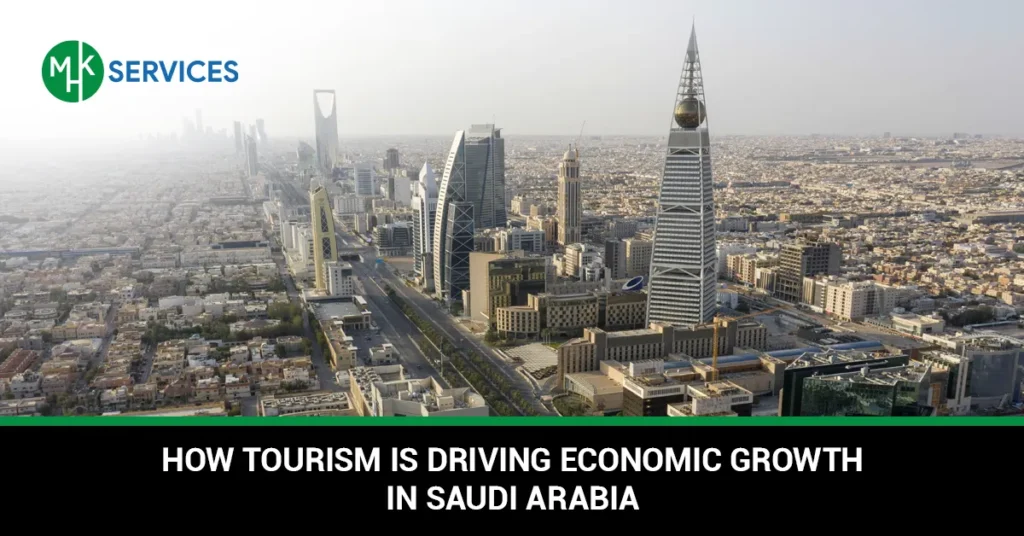
A decade ago, Saudi Arabia had no tourist visa and few destinations known outside the region. Today, the story is completely different. MHK Services has watched this shift unfold closely, and the numbers behind it are hard to ignore: tens of millions of annual visitors, tens of billions of dollars in spending, and an economy that is visibly less dependent on oil than it was ten years ago. This piece looks at Tourism and Economic Growth in Saudi Arabia through four connected pillars, each explaining a different part of how travel became one of the Kingdom’s most important growth engines.
Understanding Tourism and Economic Growth in Saudi Arabia
Before looking at the individual drivers, it helps to see the bigger picture. Tourism and Economic Growth in Saudi Arabia are now tightly linked, with the sector’s direct GDP contribution climbing from roughly 3% at the start of Vision 2030 to close to 5–10% today, depending on how the figure is measured. By the end of 2025, the Kingdom had welcomed over 120 million tourists in a single year, generating well over SAR 300 billion in total spending and surpassing an original 2030 target years ahead of schedule.
That scale of growth doesn’t happen by accident. It is the result of four deliberate pillars working together: policy reform, giga-project investment, job creation, and international positioning. Each pillar reinforces the others policy opens access, investment builds the physical destinations, job creation spreads the economic benefit across society, and global positioning brings in the visitor spending that makes the whole system self-sustaining rather than dependent on continuous government subsidy.
Pillar 1: Vision 2030 and Saudi Tourism Expansion
The foundation of everything is policy. Saudi Tourism simply did not exist as a formal industry before Vision 2030 introduced e-visas, opened the country to leisure travelers, and created a dedicated Ministry of Tourism with clear national targets. The strategy set an ambitious goal of raising annual visits toward 150 million by 2030, split between domestic and international travelers, alongside a target of pushing tourism’s GDP share into double digits.
This is not a vague aspiration. It comes with a national tourism strategy that names eleven priority destinations including Riyadh, Jeddah, AlUla, the Red Sea coast, and Diriyah each with its own development plan, investment pipeline, and target visitor segment. The strategy also splits its visitor targets between domestic and international travelers, recognizing that a resilient tourism base needs strong local demand to cushion it against global travel shocks, not just inbound arrivals. Authorities have also simplified entry procedures dramatically, replacing what used to be a complicated visa process with fast digital applications that take minutes rather than weeks.
Pillar 2 : Giga-Projects Fueling the Saudi Economy
The second pillar is physical: giga-projects. Developments like the Red Sea resorts, AMAALA, Qiddiya, and the historic Diriyah district are not just tourism attractions they are massive construction and investment programs that ripple through the wider Saudi Economy. Hotel construction alone generates employment across interior design, building materials, logistics, and skilled trades, long before the first guest ever checks in.
These projects also attract foreign direct investment at a scale the Kingdom hasn’t seen before. Inflows have grown several times over in less than a decade, and more than 700 international companies have now set up regional headquarters inside Saudi Arabia, compared with fewer than 50 just a few years earlier. Much of that relocation decision is tied directly to confidence in the country’s tourism and hospitality growth story. Executives repeatedly cite predictable regulation, improving infrastructure, and a growing base of skilled local talent as reasons for choosing Riyadh over other regional hubs factors that trace back, at least in part, to the sustained investment poured into tourism-linked infrastructure over the past several years.
| Metric | Recent Level | Direction |
| Annual tourist visits | 120+ million (2025) | Rising toward 150M target |
| Tourism GDP contribution | ~5% and climbing | Target: 10% by 2030 |
| International tourist spending | SAR 168.5B+ (2024) | Up sharply from 2019 baseline |
| Foreign direct investment inflows | Multiple times 2017 levels | Continued growth expected |
Pillar 3 : Jobs and the Wider Push Behind Tourism and Economic Growth in Saudi Arabia
Tourism and economic growth in Saudi Arabia are closely connected through employment. The national strategy aims to create more than 1.5 million tourism-related jobs across several industries, including:
- Hospitality: Hotels, resorts, restaurants, and guest services.
- Transport: Airlines, travel services, transportation, and logistics.
- Retail and Entertainment: Shopping, events, attractions, and entertainment venues.
- Local Businesses: Tour operators, food businesses, craft producers, and other tourism-related SMEs.
Tourism also supports Saudi Arabia’s wider economic diversification and Saudization goals. Unlike the oil sector, which is generally capital-intensive and specialized, tourism creates employment opportunities across a broader range of skills.
Small and medium-sized businesses are another major beneficiary. The number of registered SMEs in the Kingdom has grown from around 429,000 to more than 1.7 million in less than a decade. Many are connected directly or indirectly to the tourism supply chain.
A new resort or heritage destination, for example, does more than attract visitors. It creates demand for local suppliers, transportation providers, service businesses, restaurants, tour operators, and independent entrepreneurs. This allows tourism growth to spread its economic benefits beyond major projects and into local communities.
Pillar 4 : Global Positioning and Tourism and Economic Growth in Saudi Arabia
Saudi Arabia is also working to build a stronger position in the global tourism market. Through campaigns such as Visit Saudi, the Kingdom is changing how international travelers view the country. Instead of being known mainly for religious travel, Saudi Arabia is now promoting itself as a destination for luxury, culture, adventure, entertainment, and business travel.
Global events are playing an important role in this transformation. Major sporting events, Expo 2030 in Riyadh, and the 2034 FIFA World Cup are helping Saudi Arabia gain greater international visibility. These events can also attract new visitors who may return later for leisure or business travel.
The economic impact goes beyond the number of visitors. Business travelers and event tourists often spend more on hotels, restaurants, transportation, shopping, and entertainment. This creates additional revenue for businesses across the tourism sector.
Religious tourism will continue to provide a strong and reliable source of visitors. At the same time, the growth of leisure, luxury, sports, and corporate travel is helping Saudi Arabia diversify its tourism economy. Together, these segments are increasing visitor spending and creating new opportunities across the wider Saudi economy.
What This Means for Tourism and Economic Growth in Saudi Arabia Going Forward
Put the four pillars together, and a clear pattern emerges: policy reform opened the door, giga-projects built the destinations, job creation spread the benefits across the population, and global positioning brought in the spending power to sustain it all. As Vision 2030 enters its final phase through 2030, the emphasis is shifting from building infrastructure to maximizing returns on what has already been built meaning the next few years are likely to be about efficiency, higher-value visitors, and deeper private sector participation in the Saudi Economy.
Conclusion
Tourism and Economic Growth in Saudi Arabia are now two sides of the same story, with policy reform, infrastructure investment, job creation, and global branding all reinforcing one another. For businesses and investors trying to understand where the next opportunities lie, this sector offers one of the clearest, most measurable examples of Vision 2030 in action. MHK Services helps organizations make sense of exactly these shifts, turning national-level trends into practical entry and growth strategies whether that means evaluating a new market entry, identifying the right local partners, or simply understanding how fast this sector is likely to keep moving.
Frequently Asked Questions
How much does tourism actually contribute to Saudi Arabia’s economy?
Current estimates put tourism’s direct GDP contribution at roughly 5%, with an official target of reaching around 10% by 2030.
What is driving the recent surge in tourist visits?
Simplified e-visas, new giga-project destinations, and an expanding calendar of global events are the main drivers.
Are these gains limited to big cities like Riyadh and Jeddah?
No, growth spans eleven priority destinations, including AlUla, the Red Sea coast, Diriyah, and other regional hubs.
How many jobs is the tourism sector expected to create?
The national strategy targets over 1.6 million tourism-related jobs across hospitality, transport, and related services.
Is Saudi Arabia on track to hit its 2030 tourism targets?
Visitor numbers have already surpassed the original 100 million target, though the more ambitious 150 million goal will take continued momentum.