
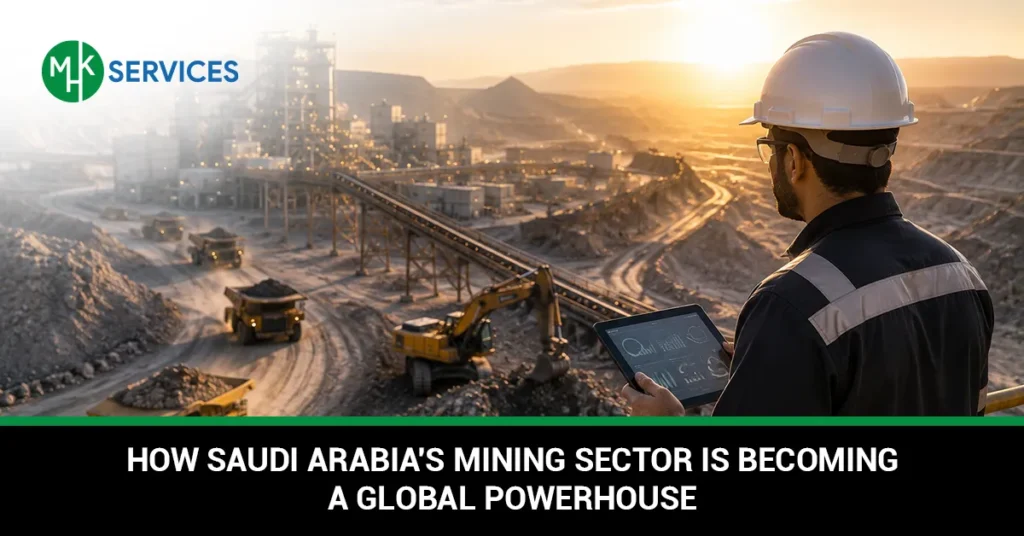
For decades, oil defined the Kingdom’s economic identity almost entirely. That’s changing. The Mining Sector Saudi Arabia is now positioned as the third pillar of the national economy, sitting alongside oil and petrochemicals as a genuine growth driver rather than an afterthought. At MHK Services, we’ve watched this shift unfold in real time, working with organizations trying to understand where the real opportunities and the real risks sit within this emerging market.
Why This Shift Is Happening Now
Saudi Arabia sits on mineral wealth estimated in the trillions of dollars, much of it barely explored until recently. Phosphate, gold, copper, and rare earth deposits scattered across the country have long been known to exist; what’s new is the political and financial will to actually develop them at scale. Three things changed this equation:
- National strategy: mining was formally designated a priority sector under Vision 2030, unlocking dedicated funding and regulatory attention.
- Global demand: the world’s shift toward electric vehicles and renewable energy has sharply increased demand for the exact minerals the Kingdom holds.
- Diversification pressure: reducing oil dependency isn’t optional anymore; it’s a stated national goal with mining as one of its main pillars.
The Scale of Saudi Mining Investment
Government-backed Saudi Mining Investment has moved from modest exploration grants to genuinely large capital commitments. The Public Investment Fund and the Ministry of Industry and Mineral Resources have both put substantial money behind exploration licensing, processing infrastructure, and joint ventures with international mining companies. This isn’t a case of a government simply hoping private capital shows up; it’s actively co-funding the groundwork needed to make private investment viable in the first place.
What’s Actually Being Mined
| Mineral | Estimated Value / Role | Primary Use |
| Phosphate | Multi-billion dollar reserves | Fertilizer production |
| Gold | Long-established, expanding output | Jewelry, reserves, export |
| Copper | Growing exploration focus | Electronics, renewable energy infrastructure |
| Rare earth elements | Early-stage but strategically significant | EV batteries, electronics, defense |
Building an Industry From Near Scratch
Unlike oil, which had decades of infrastructure already in place, the Mining Sector Saudi Arabia has needed to build processing facilities, transport links, and a trained workforce almost from the ground up. That’s a slower process than simply signing licensing deals; refineries, rail lines to move ore, and port capacity for export all take years to construct. The government’s approach has been to fund this infrastructure directly rather than wait for it to emerge organically, which is a major reason development has moved faster than similar efforts elsewhere.
How the Mining Industry Saudi Arabia Ecosystem Is Maturing
A mining industry doesn’t function on deposits alone it needs geological survey data, assay labs, engineering talent, and financing structures suited to long project timelines. Over the past several years, the Mining Industry Saudi Arabia has developed all of these in parallel rather than sequentially, which is unusual and has compressed a development timeline that typically takes much longer in other emerging mining markets.
International Partnerships Driving Momentum
Foreign mining majors have taken notice. Exploration agreements and joint ventures with established international players bring something the Kingdom didn’t have in abundance domestically: decades of technical mining expertise. These partnerships also signal something to other potential investors: that the risk profile of operating within the Mining Sector Saudi Arabia is considered acceptable by companies with global mining experience and plenty of alternative markets to choose from.
Comparing This Push to Past Diversification Efforts
Saudi Arabia’s current mining strategy differs from earlier diversification efforts in two important ways:
| Key Difference | Current Mining Push |
| Stronger Capital Commitment | Backed by substantial government investment and long-term funding for exploration, infrastructure, and industry development. |
| Growing Global Demand | Benefits from strong international demand for minerals used in electric vehicles, renewable energy, electronics, and other industries. |
The Role of Technology and Exploration Data
Modern exploration techniques have also accelerated the timeline considerably. Satellite geological surveys, combined with artificial intelligence-assisted mineral mapping, have allowed the Kingdom to identify promising deposits far faster than traditional ground surveys alone would have permitted. This matters because exploration used to be the slowest, most expensive part of building out a mining sector. Compressing that phase means capital can move toward actual extraction and processing sooner, which in turn strengthens the overall case for Mining Sector Saudi Arabia as a credible near-term growth story rather than a decades-away ambition.
The Obstacles Still Ahead
None of this is without friction. Permitting timelines, water access in arid exploration zones, and the sheer cost of building processing infrastructure from scratch all remain real constraints. Attracting and training a skilled mining workforce is also a multi-year undertaking, not something solved by capital alone. Growth in Saudi Mining Investment will likely continue, but the pace depends heavily on how quickly these structural bottlenecks get resolved.
The Workforce Question
Building a skilled domestic mining workforce is an important part of developing a sustainable industry:
Specialized Education: Universities and vocational programs are expanding courses in geology, metallurgy, and mining engineering.
International Training: Partnerships with international mining operators often include training programs to develop local technical expertise.
Long-Term Sustainability: A domestically trained workforce can help the Mining Sector Saudi Arabia become more self-sustaining and reduce long-term reliance on imported technical expertise.
What This Means for Investors and Businesses
For companies evaluating entry into this market, several factors can make a significant difference:
- Timing Matters: Early movers who understand licensing processes, regional geology, and government priorities can secure better positioning.
- Local Knowledge: Understanding local regulations, operating conditions, and government priorities is essential when entering an emerging mining market.
- Local Partnerships: Building relationships with local partners can help companies navigate a regulatory and operational landscape that is still evolving.
- Start Strategically: Companies can benefit from treating their initial market entry as a learning exercise, building relationships and understanding local processes before committing major capital.
- Stay Updated: With regulations changing quickly, keeping track of policy developments is almost as important as understanding the underlying geology.
Where the Sector Is Headed
If current trends hold, the Mining Sector Saudi Arabia could realistically become one of the country’s largest non-oil revenue sources within the next decade. That’s an ambitious target, but the combination of proven reserves, sustained government funding, and rising global mineral demand gives it more credibility than similar diversification pledges have historically had elsewhere in the region.
Conclusion
The transformation of Saudi Arabia’s mining sector isn’t a side story to the Kingdom’s broader economic diversification; it’s becoming one of its central chapters. Continued Mining Sector Saudi Arabia development, backed by serious capital and international partnerships, suggests this is a structural shift rather than a temporary policy push. For businesses trying to understand where the next major opportunity in the region sits, this sector deserves serious attention, and MHK Services can help make sense of what’s actually happening on the ground versus what’s just headline noise.
Frequently Asked Questions
Why is Saudi Arabia investing so heavily in mining now?
Vision 2030 designated mining a priority sector, and rising global demand for minerals used in EVs and renewables has made the timing especially favorable.
What minerals does Saudi Arabia actually produce?
Phosphate, gold, and copper are the most established, with rare earth elements gaining strategic attention more recently.
Is foreign investment allowed in Saudi mining projects?
Yes, international mining companies are actively forming joint ventures and exploration partnerships within the Kingdom.
What are the biggest challenges facing the sector?
Infrastructure development, water access for exploration, and building a skilled domestic workforce remain the main constraints.
How big could Saudi Arabia’s mining sector become?
Government projections suggest it could become one of the largest non-oil contributors to GDP within the next decade if current investment trends continue.