
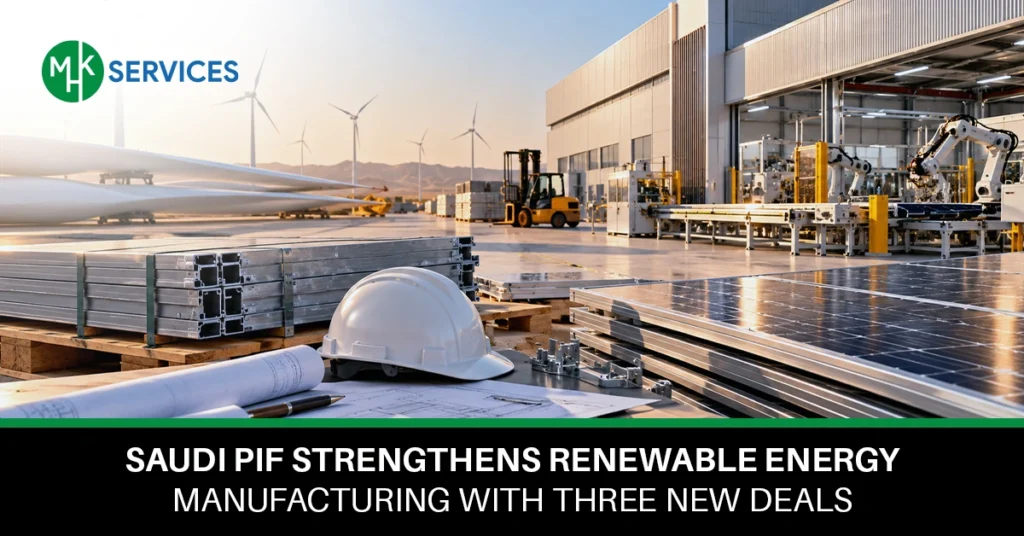
Saudi Arabia is building one of the most promising clean energy markets in the region, and a fresh move by the Public Investment Fund shows how serious this plan really is. Three new manufacturing deals have been signed to grow local production of solar and wind equipment, marking another step forward for Saudi PIF Renewable Energy plans.
These agreements bring global manufacturers together with Saudi partners to build factories, create jobs, and cut reliance on imported energy equipment. For companies like MHK Services that follow industrial growth in the Kingdom closely, this news signals a real shift toward local production. This article breaks down what these deals mean and what opportunities they may open for local businesses.
What Are the Three Renewable Energy Deals Signed by PIF?
The three deals focus on building local factories for solar and wind equipment inside Saudi Arabia. One agreement involves a major solar manufacturer set to produce ingots, wafers, and solar cells within the Kingdom. Another partnership brings in a global solar module maker to expand production of finished solar panels.
The third deal targets wind energy, bringing in a turbine and blade manufacturer to set up local production lines. Each partner brings years of manufacturing experience, while the Saudi side offers land, funding support, and market access. Together, these deals form an important part of the wider push that Renewable Energy Manufacturing Saudi Arabia has been working toward, aiming to build a complete local supply chain instead of relying on imports.
How Will the Three Deals Impact Saudi Renewable Energy Manufacturing?
These deals are set to change how renewable energy equipment is produced in the Kingdom. Instead of shipping panels and turbine parts from other countries, Saudi Arabia will soon manufacture many components locally.
This shift can lower costs over time, cut shipping delays, and create more jobs for Saudi workers. It also means future solar and wind projects can move faster, since materials will not need to travel long distances. For businesses in construction, logistics, or engineering, this opens new work with local factories. Overall, these deals push Saudi PIF Renewable Energy manufacturing capacity toward becoming one of the strongest in the region.
What Role Does a Renewable Energy Localization Company Play?
A renewable energy localization company plays a central part in making Saudi PIF Renewable Energy manufacturing deals work on the ground, and firms such as MHK Services often help guide this process.
- They guide global partners through Saudi regulations, permits, and industrial zone requirements.
- They build partnerships between global manufacturers and Saudi companies.
- They support local renewable energy supply chains by linking factories with nearby suppliers.
- They assist with technology transfer, helping Saudi engineers gain hands-on training.
- They provide ongoing support for local production, keeping factories ready to scale.
How Do the Deals Support Saudi Arabia’s 2030 Renewable Energy Goals?
These deals connect directly to a larger goal known across the region as Saudi PIF Renewable Energy expansion, tied closely to the Kingdom’s 2030 roadmap.
- They support Saudi Arabia’s 2030 renewable energy targets for clean electricity generation.
- They connect with the National Renewable Energy Program guiding solar and wind development nationwide.
- They increase local production of components, reducing the need for imports.
- They support Vision 2030 industrial goals by making Saudi Arabia a manufacturing hub.
- They grow Saudi renewable energy supply chains, giving local suppliers a stronger role.
What Do the Deals Mean for Saudi Solar Manufacturing?
Solar manufacturing starts with ingots, blocks of purified silicon, which are sliced into thin wafers and processed into solar cells that convert sunlight into electricity. These cells are then assembled into complete solar modules, the panels seen on rooftops and solar farms.
The Jinko Solar deal focuses on building this process locally, while the LUMETECH and TCL Zhonghuan partnership adds further capacity for wafer and module production. This means the full solar chain, from raw silicon to finished panels, can soon happen within Saudi Arabia. This step forward in Saudi PIF Renewable Energy manufacturing strengthens local supply chains and supports faster delivery for upcoming solar projects nationwide.
What Do the Deals Mean for Wind Energy Manufacturing in Saudi Arabia?
The Envision Energy deal focuses specifically on wind power equipment, including turbine components and the large blades needed for wind farms. This partnership aims for an annual production capacity of around 4 GW, a significant volume for a market still growing. Building wind turbine parts locally means fewer delays from shipping and customs.
It also opens doors for local suppliers offering steel, electrical parts, and other materials needed during production. Supporting industries such as transport, warehousing, and technical maintenance will likely see rising demand as this facility becomes fully operational.
How Could PIF’s Deals Affect Saudi Businesses?
Local businesses across several industries, including partners of MHK Services, stand to benefit from these new manufacturing partnerships in different ways.
- Component suppliers may see rising demand for glass, cables, and electrical parts.
- Engineering and technical service firms could gain work in factory design and installation.
- Construction and infrastructure businesses may win contracts for factory sites and warehouses.
- Logistics providers could benefit from more materials moving between factories and ports.
- Maintenance and industrial service companies may find steady long-term work.
Why Are Global Renewable Energy Manufacturers Partnering with Saudi Arabia?
Saudi Arabia’s renewable energy market has grown quickly, attracting attention from manufacturers worldwide. Large-scale solar and wind projects across the Kingdom create steady demand for equipment, making local production a smart business decision. Government requirements for local manufacturing also encourage global companies to build factories inside the country rather than simply exporting products.
In return, these manufacturers bring valuable international technology and years of production expertise that raise local standards. Many companies also see the Kingdom as a gateway to nearby regional markets, making PIF Investment Saudi Arabia partnerships attractive for long-term growth.
How Do These Deals Fit Into PIF’s Wider Renewable Energy Strategy?
These three deals sit inside a much bigger Saudi PIF Renewable Energy investment picture, reflecting broader PIF Investment Saudi Arabia priorities that link energy generation with local manufacturing.
- They link renewable energy generation projects with the factories that supply equipment.
- They reflect a strategy focused on long-term economic growth, not short-term purchases.
- They support Saudi Arabia’s wider industrial ecosystem, benefiting suppliers and service providers.
- They encourage private-sector participation, opening doors for local companies to grow.
- They expand renewable energy supply-chain localization across the sector.
What Challenges Could Affect Saudi Renewable Energy Manufacturing?
While these deals bring exciting opportunities, industry watchers such as MHK Services point out that there are real challenges to manage as manufacturing scales up across the Kingdom.
- Developing new facilities takes time, planning, and significant investment.
- There is a growing need for skilled workers and technical training.
- Building competitive local supplier networks takes time and effort.
- Matching production capacity with actual project demand can be tricky.
- Meeting international quality and cost standards remains essential to compete.
What Could These Deals Mean for Saudi Arabia’s Renewable Energy Industry?
Looking at the bigger picture, these three deals represent meaningful progress for local manufacturing growth across the renewable energy sector. They support stronger supply-chain development, meaning fewer delays and lower costs for future projects. Private companies now have clearer openings to enter the market, whether by supplying materials or offering technical services.
These deals also encourage technology and workforce development, giving Saudi engineers and workers hands-on experience. Beyond energy alone, the wider industrial impact could touch construction, logistics, and manufacturing sectors, helping diversify the economy while supporting long-term clean energy ambitions.
What Happens Next for Saudi Renewable Energy Manufacturing?
In the coming months, attention will turn to actual manufacturing facility development, as construction begins on the new factories tied to these three deals. Production timelines and capacity targets will become clearer as building work progresses. Local supplier participation will likely increase as factories look for nearby partners to provide materials and support services.
Workforce development programs are also expected to expand, preparing Saudi workers for technical roles. As more solar and wind projects are announced, future demand should keep rising, pushing Renewable Energy Manufacturing Saudi Arabia efforts closer to the Kingdom’s 2030 localization target.
Conclusion
These three manufacturing deals mark an important milestone in the Kingdom’s clean energy journey. By bringing global expertise together with local investment, Saudi PIF Renewable Energy plans are moving from vision toward reality, building factories that will produce solar panels and wind turbine parts right here in the region.
For businesses watching these developments, including MHK Services, this signals that opportunities in construction, supply, logistics, and technical services are only expected to grow. As these factories come online, they will support Vision 2030 goals while strengthening the Kingdom’s position in global renewable energy manufacturing. The road ahead looks promising, and MHK Services will continue following these developments closely.
FAQs
What are the three renewable energy deals signed by PIF?
The three deals cover solar manufacturing with Jinko Solar, additional solar production with LUMETECH and TCL Zhonghuan, and wind turbine manufacturing with Envision Energy.
Why is local renewable energy manufacturing important for Saudi Arabia?
Local manufacturing reduces reliance on imports, creates jobs, lowers long-term costs, and supports faster delivery for solar and wind projects across the Kingdom.
How do these deals connect to Vision 2030?
These deals support Vision 2030 industrial development goals by turning Saudi Arabia into a manufacturing hub for renewable energy equipment, not just a buyer of finished products.
What industries could benefit from these new manufacturing deals?
Industries such as construction, logistics, engineering, component supply, and industrial maintenance are likely to see new business opportunities as factories become operational.
What challenges might affect Saudi renewable energy manufacturing growth?
Key challenges include building new facilities, training skilled workers, developing local supplier networks, and meeting international quality and cost standards.