
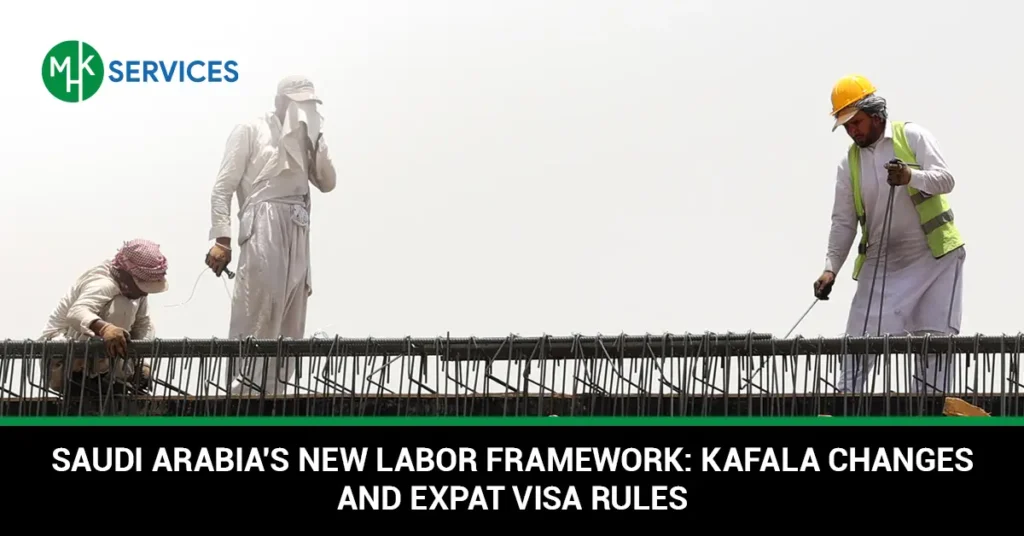
Saudi Arabia continues to update its employment and immigration rules to support a more organised labour market and protect contractual rights. These changes affect expatriates who want to change employers, renew their residency permits, travel outside the Kingdom or resolve employment disputes. Understanding the Kafala System Saudi Arabia helps workers and businesses identify their rights and responsibilities under the current framework.
The reforms have given eligible private-sector employees greater freedom to move between employers, but they have not removed every sponsorship-related requirement. MHK Services helps businesses understand employment compliance requirements and manage the administrative responsibilities associated with expatriate employment.
What Has Changed in the Kafala System in Saudi Arabia?
The traditional sponsorship system linked an expatriate worker’s legal employment and residency status closely to a Saudi employer, often called a sponsor or kafeel. This arrangement could restrict a worker’s ability to change jobs or leave the country without following the required procedures.
Saudi Arabia introduced its Labour Reform Initiative on 14 March 2021. The initiative gave eligible private-sector expatriates greater freedom to transfer jobs and request exit and re-entry or final exit services under specified conditions.
The Saudi Labour Reforms changed employment mobility, contractual relationships, and administrative procedures. They also increased the importance of documented employment contracts and official electronic services.
However, the government did not remove every sponsorship requirement. Workers must still follow applicable labour and immigration rules, maintain required documents, and meet the conditions for their employment category.
Why the Saudi Labour Reforms Matter to Expatriates
The changes can help eligible workers pursue new employment opportunities without relying on the same employer for every step. Employers must also pay closer attention to contracts, work permits, employee transfers and residency records.
The Kafala System Saudi Arabia now operates within a changing regulatory framework. Workers should assess their individual circumstances instead of assuming that every expatriate enjoys identical rights.
Which Expatriates Can Change Employers Without the Current Sponsor’s Approval?
Saudi Arabia allows eligible expatriate employees in the private sector to transfer to another employer under the applicable mobility rules. However, the right to transfer depends on the worker’s circumstances, employment contract and compliance status.
An employee may qualify for a transfer under conditions involving contract expiry, notice requirements or specific circumstances recognised by the labour regulations. The relevant electronic system determines the applicable process and checks the required conditions.
Before accepting a new position, expatriates should review the following points:
- Employment contract: Check the contract’s expiry date, notice period and termination clauses.
- Work permit: Confirm that the work permit and employment records meet the transfer requirements.
- Residency status: Review the Iqama validity and any outstanding immigration issues.
- New job offer: Confirm that the prospective employer can legally recruit and register the worker.
- Transfer conditions: Check whether the case requires a notice period or meets an exception under the applicable rules.
Workers should not resign or stop attending work based on assumptions about their transfer eligibility. An incorrect decision may create employment disputes or affect their legal status.
MHK Services can help employers review their employment documentation and identify administrative issues that may affect expatriate recruitment and staff transfers.
How to Transfer Employment Through Qiwa
Qiwa serves as an official digital platform for many private-sector employment services in Saudi Arabia. Eligible employees and employers can use it to manage employment offers, contracts and applicable transfer procedures.
The standard process generally follows these steps:
- The new employer submits an offer: The prospective employer starts the transfer process through the relevant Qiwa service.
- The employee reviews the offer: The worker checks the job title, salary, contract terms and other conditions before accepting.
- The system checks eligibility: Qiwa applies the relevant transfer conditions and identifies any outstanding requirements.
- The transfer proceeds: The parties complete the required steps and notifications under the applicable procedure.
- The employer updates the records: The new employer completes the necessary employment and work permit formalities.
Why Can a Transfer Application Face Delays?
A transfer may encounter problems if the employer does not meet the relevant requirements, the worker’s records contain errors, or the application does not satisfy the applicable rules. Contract disputes and unresolved employment status issues may also require attention.
Employees should review the reason for a delay through the official platform and seek clarification from the responsible authority when necessary. Employers should check their establishment records before starting a transfer.
Qiwa procedures and eligibility conditions may change, so both parties should follow the current instructions displayed on the platform rather than relying on outdated advice.
Expat Visa Saudi Arabia: Work Permits, Iqama and Travel Rules
Expatriates must distinguish between permission to work, permission to reside in the Kingdom and permission to travel outside the country. Each document serves a different purpose, and one does not automatically replace another.
Work Visas and Iqama Requirements
A foreign national applying for an Expat Visa Saudi Arabia for ordinary employment generally needs the appropriate work visa and must complete the required employment and residency procedures. The employer normally handles key recruitment and work authorisation steps.
The Iqama serves as the expatriate’s residence permit. Workers must keep their residency status valid and follow the rules governing employment, passport details, and permit renewals.
Employers should monitor expiry dates and complete required renewals on time. Expatriates should check their records and report errors promptly instead of waiting until a permit expires.
A valid Iqama does not automatically authorise a worker to take a different job. The employee must also satisfy the applicable employment and work permit conditions.
Exit and Re-entry Visas
An exit and re-entry visa allows an eligible resident to leave Saudi Arabia temporarily and return within the permitted period. The applicant must follow the applicable issuance conditions and check the visa’s validity before travelling.
Workers should confirm that their passport, residency records and travel documents meet the requirements. They should also check the visa details carefully to avoid problems at departure or when returning to the Kingdom.
The official Absher platform provides relevant visa services and status enquiries. The available process depends on the applicant’s category and circumstances.
Final Exit Visas
A final exit visa concerns permanent departure from Saudi Arabia rather than temporary travel. Expatriates should check the applicable conditions, employment arrangements and outstanding obligations before completing the process.
Workers who have unpaid wages, unresolved disputes or questions about end-of-service benefits should obtain suitable guidance before leaving. They should also confirm the effect of their departure on any pending claim.
Employers must follow the relevant rules when handling final exit procedures. They should not assume that an employee’s departure removes their responsibility to address valid employment obligations.
What Happens When an Expatriate Receives an Absent-from-Work Status?
An absent-from-work record can affect an expatriate’s employment status and ability to continue working legally. Workers should act promptly if their employer reports an absence or if the official system records their employment as discontinued.
On 18 September 2025, the Ministry of Human Resources and Social Development introduced an initiative through Qiwa to help eligible professional workers regularise their status and transfer legally to a new employer.
The initiative covers specified cases involving workers whose status changed after a grace period following work discontinuation, workers whose documented contracts expired or ended, and certain workers with earlier absence reports.
The government set conditions for participation. These include a requirement for the new employer to cover specified outstanding work permit fees and a continuous period of at least 12 months in Saudi Arabia before the relevant work discontinuation or contract expiry.
This initiative does not grant automatic transfer rights to every worker with an absence record. Eligibility depends on the circumstances and the official conditions.
Expatriates should check their status through Qiwa and obtain guidance before accepting another job or taking steps that could affect their residency.
Do the Same Kafala System Saudi Arabia Rules Apply to Every Type of Worker?
No. Saudi Arabia applies different rules to different employment categories, so expatriates should identify the regulations that cover their actual role.
Private-Sector Employees
The Labour Reform Initiative covers eligible private-sector expatriates who meet the relevant conditions. Their ability to transfer employment depends on the applicable mobility rules, contract arrangements and official records.
Domestic Workers
Domestic workers, including household employees, follow a separate regulatory framework for relevant employment and recruitment matters. The rules that apply to an office employee or a private-sector professional may not apply in the same way to a domestic worker.
Musaned provides official services related to domestic worker recruitment and employment. Workers and employers should consult the relevant rules before making changes to a domestic worker’s employment arrangements.
Workers in Other Regulated Occupations
Some occupations and employment categories have additional requirements. Agricultural roles, regulated professions and jobs subject to specific licensing or Saudisation conditions may require further checks.
Employees should confirm their job classification, work permit conditions and transfer eligibility before changing positions. Employers should also check whether the proposed role requires professional qualifications, registration or other approvals.
How New Work Permit Classifications Affect Expatriates in 2026
Saudi Arabia introduced a work permit classification system that groups expatriate workers into three skill categories: high-skill, skilled and basic. The Ministry of Human Resources and Social Development announced the measure in July 2025, with implementation stages for existing and incoming workers.
The classification system links work permits to factors such as a worker’s occupation, qualifications and other criteria set out in the official guidance. It helps the government assess whether a worker’s profile matches the requirements of the relevant role.
Expatriates should check that their recorded occupation reflects their actual work and qualifications. An incorrect classification may create administrative problems, particularly when an employee changes roles or an employer updates workforce records.
Employers should review job descriptions, professional credentials and permit information before recruiting or transferring staff. They should also check current Saudisation requirements and any professional accreditation rules that apply to the position.
The classification system forms part of the wider labour policy framework, but it does not give every worker an automatic right to change employers or occupation.
What Rights Do Expatriate Workers Have Under Saudi Labour Law?
Saudi labour law provides employment protections that depend on the worker’s category and the applicable regulations. Expatriates should understand their contractual rights and keep evidence of their employment arrangements.
Key areas include:
- Written employment contracts: Workers should review their recorded contract, including salary, duties, working hours and termination terms.
- Wage payments: Employees should retain payslips and other evidence of salary payments. They should report unpaid or delayed wages through the appropriate official channels.
- Working conditions: Employers must follow the employment standards and workplace rules that apply to their staff.
- End-of-service benefits: Eligible employees should review their entitlement under the applicable law and contract when employment ends.
- Labour complaints: Workers can use the relevant Ministry of Human Resources and Social Development services to raise employment concerns and seek dispute resolution.
Employees should keep copies of contracts, salary records, messages about employment changes and any official complaints. Clear records can help explain a dispute and support a claim.
Employers should address complaints promptly and maintain accurate employment records. A disagreement over wages, resignation or contract termination does not remove the need to follow the applicable legal process.
What Employers Must Do to Meet Saudi Labour Requirements
Employers must manage employment and immigration obligations throughout an expatriate’s time in Saudi Arabia. The reforms require businesses to pay close attention to contracts, staff transfers, work permits and employee records.
Employers should:
- Maintain accurate employment contracts and update them through the appropriate systems.
- Monitor work permit and Iqama expiry dates.
- Follow the correct procedures when recruiting, transferring or terminating expatriate employees.
- Pay wages according to the applicable rules and maintain supporting records.
- Check occupational classifications, professional requirements and Saudisation obligations.
- Respond appropriately to employment complaints and disputed absence records.
MHK Services can support businesses with employment administration, documentation reviews and compliance-related procedures. Employers should assess their specific obligations against current official requirements rather than assume one process covers every worker.
Where Can Expatriates Check Their Employment and Visa Status?
Workers and employers should use official Saudi government platforms to check requirements and complete relevant procedures.
- Qiwa: Employment contracts, job offers, eligible employment transfers and related labour services.
- Absher: Relevant residency and visa services, including available exit and re-entry or final exit procedures.
- Ministry of Human Resources and Social Development: Labour regulations, employment guidance and complaint services.
- Musaned: Domestic worker recruitment and related services.
The correct platform depends on the service and the worker’s category. Users should check the current eligibility conditions, required documents and application status before making employment or travel decisions.
Conclusion
Saudi Arabia’s labour framework has given eligible expatriates greater employment mobility while retaining important work authorisation and residency requirements. Workers need to understand their contract, transfer eligibility, Iqama status and travel conditions before making employment decisions. Employers must maintain accurate records and follow the procedures that apply to each worker category.
The Kafala System Saudi Arabia continues to change through specific reforms and administrative measures. MHK Services can help businesses review employment documentation and understand their compliance responsibilities under the current framework.
Get Support With Saudi Labour and Expatriate Compliance
Do you need help reviewing employment records, expatriate work permits or labour compliance procedures in Saudi Arabia? Contact MHK Services to discuss your requirements and identify the appropriate steps for your business. A review of your circumstances can help you understand the relevant rules and prepare the required documentation.
FAQs
Has the Kafala System Saudi Arabia Been Completely Abolished?
No. The reforms reduced certain sponsorship restrictions and gave eligible workers greater job mobility, but relevant immigration requirements and category-specific rules still apply.
Can an Expatriate Change Jobs Without the Current Employer’s Approval?
Eligible workers may transfer under the applicable rules, but the process depends on their contract, employment status and the conditions that govern their case.
Can an Expatriate Leave Saudi Arabia Without the Employer’s Permission?
The rules allow eligible residents to use the relevant exit and re-entry or final exit procedures, subject to the applicable requirements. Workers should check their specific situation before travelling.
Can an Expatriate Transfer Jobs With an Expired Iqama?
An expired Iqama can create complications, but the available options depend on the worker’s circumstances and current regulations. The employee should check the official system and obtain guidance before proceeding.
Do Domestic Workers Follow the Same Rules as Private-Sector Employees?
No. Domestic workers follow a separate regulatory framework for relevant employment matters, so they should consult the rules and services that apply to their category.