
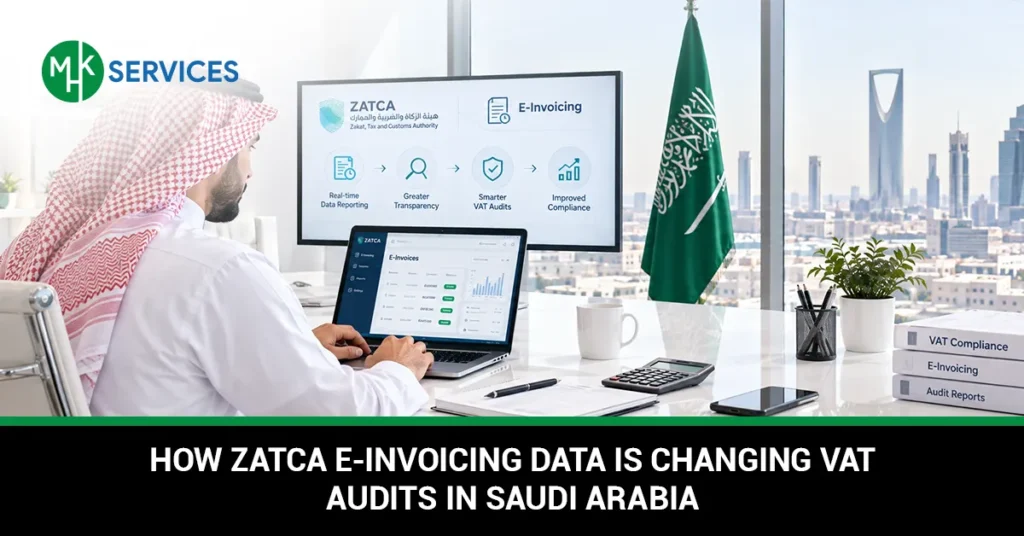
Something has quietly shifted in how tax authorities in the Kingdom look at businesses, and it isn’t a new law buried in fine print; it’s data. The rollout of ZATCA e-invoicing VAT audits has moved tax scrutiny away from occasional paperwork checks toward continuous, system-level visibility. At MHK Services, we’ve watched clients go from viewing e-invoicing as a compliance checkbox to realizing it fundamentally changes how and how often they get audited.
A Quick Look Back: Why This Change Happened
For years, VAT audits in Saudi Arabia relied heavily on sampled invoices, manual reconciliations, and whatever documentation a business chose to hand over during a review. That approach had obvious gaps; errors could go unnoticed for months, and inconsistent record-keeping made it easy, intentionally or not, for discrepancies to slip through.
Under that older model, ZATCA e-invoicing VAT audits simply didn’t exist in the form they do today. Auditors worked with whatever paper trail or exported spreadsheet a company handed over, which meant the accuracy of an audit depended heavily on how organized or disorganized a business happened to be at the time of review.
ZATCA e-invoicing Saudi Arabia requirements were introduced precisely to close those gaps. By requiring invoices to be generated and, in the case of Phase 2, transmitted and cleared through ZATCA’s systems in real time or near real time, the authority gained a live feed of transactional data rather than a retrospective snapshot handed over once a year.
What Actually Changes During a VAT Audit Now
The core shift behind ZATCA e-invoicing VAT audits is speed and precision. Where auditors once had to request sample invoices and cross-check them manually, they can now pull structured, standardized invoice data directly from the e-invoicing system.
As e-invoicing gives ZATCA more structured transaction data, businesses need stronger internal checks before an official review. Audit & Assurance Services in Saudi Arabia can help companies review financial records, internal controls, and compliance areas that may affect VAT audit readiness.
- Discrepancies between reported VAT and actual invoice data are flagged faster.
- Auditors can compare invoice patterns across time periods without waiting for a full audit cycle.
- Businesses with fragmented or manual invoicing systems face a higher chance of mismatches surfacing early.
This doesn’t necessarily mean more audits overall, but it does mean audits can be triggered more precisely, based on actual anomalies in the data rather than random selection.
Real-Time Visibility and What It Means for Businesses
One of the more significant outcomes of ZATCA e-invoicing VAT audits is that businesses effectively lose the buffer time they used to have to correct errors quietly before a review. In the old model, a mismatched invoice might sit unnoticed for months. Under the current system, structured data flows to ZATCA close to the point of transaction, meaning inconsistencies are visible much sooner.
This has pushed many finance teams to rethink how closely they monitor their own invoicing accuracy day-to-day, rather than treating VAT reconciliation as a quarterly or annual task. VAT audit Saudi Arabia processes are increasingly shaped by this real-time data trail, and businesses that still operate on manual spreadsheets are finding themselves at a structural disadvantage.
It’s worth noting that this shift isn’t unique to Saudi Arabia; several other jurisdictions across the region are moving toward similar real-time reporting models. But the pace and enforcement rigor of the Kingdom’s rollout has made it a useful reference point for how quickly a tax authority can move from periodic checks to continuous digital oversight once the right infrastructure is in place.
Where Businesses Commonly Struggle
Even well-established companies run into friction points as they adapt. A few recurring issues include:
- Legacy invoicing software that wasn’t built to generate the structured XML formats ZATCA requires.
- Inconsistent tax coding across departments or branches, which creates mismatches once data is aggregated centrally.
- Manual VAT reconciliation habits that don’t align with how quickly discrepancies now surface in ZATCA’s systems.
- Limited internal awareness of how e-invoicing compliance requirements interact with existing accounting workflows.
These gaps rarely cause problems immediately, but they tend to surface exactly when a ZATCA e-invoicing VAT audits review takes a closer look at transaction-level detail. Businesses that operate across multiple branches or subsidiaries often face an added layer of complexity, since inconsistent invoicing practices in one location can create discrepancies that ripple through consolidated VAT filings at the group level.
A Practical Compliance Snapshot
The table below outlines a simplified view of what businesses generally need to have in place, and how it ties back to audit readiness under the current e-invoicing framework.
| Area | What It Involves | Audit Relevance |
| Invoice generation format | Structured XML per ZATCA specification | Mismatched formats can flag inconsistencies |
| Integration with ZATCA systems | Phase 2 clearance/reporting connectivity | Delayed or failed transmissions draw attention |
| Internal reconciliation | Matching invoicing data to VAT returns | Reduces risk of last-minute discrepancies |
| Staff training | Awareness of e-invoicing compliance rules | Minimizes coding and entry errors |
| Record retention | Digital archiving per retention rules | Required for audit trail verification |
The Risk of Treating This as Just IT’s Problem
A common misstep is assuming compliance sits entirely with the IT department once the software is installed. In practice, VAT audit outcomes in Saudi Arabia depend just as much on how finance teams use the system day to day, how invoices are coded, how exceptions are handled, and how quickly errors get corrected. Treating e-invoicing purely as a technical rollout, rather than an ongoing finance process, is one of the most common reasons businesses get caught off guard when discrepancies surface.
This gap between technical setup and actual daily use is exactly where ZATCA e-invoicing VAT audits tend to expose weaknesses. A business can have fully compliant software and still run into trouble if the people entering and reviewing invoices aren’t trained on the nuances of tax coding, exemption categories, or how corrections should be handled once an invoice has already been transmitted.
How Businesses Are Adjusting
Forward-looking companies are responding by tightening internal controls well before an audit notice ever arrives. This includes reconciling invoice data against VAT filings more frequently, training finance staff on how e-invoicing compliance rules interact with daily invoicing, and running periodic internal checks that mimic what a ZATCA review might look for. The goal isn’t just to avoid penalties; it’s to build a system where ZATCA e-invoicing VAT audits become a routine confirmation of accuracy rather than a source of anxiety.
Some organizations are also revisiting their software stack entirely, recognizing that patched-together legacy systems create more long-term risk than the cost of a proper upgrade. Given how central ZATCA e-invoicing Saudi Arabia requirements now are to daily operations, this is increasingly viewed as a core finance investment rather than a one-off IT expense.
There’s also a growing trend of businesses bringing in outside specialists to review their invoicing setup before problems surface, rather than waiting for an audit notice to prompt a scramble. A short internal review checking data formats, reconciliation habits, and staff awareness often costs far less than untangling issues after ZATCA has already flagged them. It also gives finance leaders a clearer picture of where their real exposure sits, instead of assuming the software alone guarantees compliance.
Businesses reviewing their e-invoicing setup may also need to improve how financial data moves between systems. Digitalization & Automation Services in Saudi Arabia can help connect workflows, reduce manual data handling, and improve the consistency of information used for VAT reporting.
Why Saudi Businesses Choose MHK Services for ZATCA E-Invoicing Support
MHK Services helps businesses understand what their financial data can reveal during a ZATCA review. Our team looks at the connection between e-invoices, VAT records, reconciliations, and internal financial controls. We can help identify mismatched figures, weak documentation, and gaps that may create questions during an audit. This gives finance teams a clearer picture of the areas that need attention before ZATCA requests further information or starts a detailed review.
Closing Thoughts
The link between ZATCA e-invoicing VAT audits and day-to-day financial accuracy is only going to grow stronger as the system matures. Businesses that treat compliance as an ongoing habit, rather than a once-a-year scramble, put themselves in a far stronger position when scrutiny does arrive. At MHK Services, we help businesses build exactly that kind of steady, audit-ready compliance rhythm rather than reacting under pressure.
Frequently Asked Questions
What is the main goal of ZATCA e-invoicing?
It aims to standardize invoice data and give tax authorities real-time visibility into transactions, reducing reporting errors and tax evasion.
Does e-invoicing increase the number of VAT audits?
Not necessarily more audits, but audits become more targeted since anomalies in invoice data are identified faster and more precisely.
What businesses are required to comply with e-invoicing rules?
Most VAT-registered businesses in Saudi Arabia fall under e-invoicing requirements, with phased rollout based on revenue thresholds.
How can a business prepare for a VAT audit under the new system?
Regular reconciliation between invoicing data and VAT filings, along with staff training, significantly reduces audit-related surprises.
What happens if invoicing software isn’t compliant with ZATCA standards?
Non-compliant systems risk failed transmissions, invoice rejections, and increased scrutiny during audits, along with possible penalties.